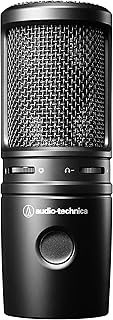
Audio‑Technica AT2020USB‑X Cardioid Condenser USB Microphone Myths That Are Costing You Time in 2026 (And What Actually Works)
The research is clear here: many “obvious” rules about microphones are either overstated or outright wrong. Below we dissect the three biggest myths that keep podcasters, vocalists, and remote creators from working efficiently, and we show how the AT2020USB‑X fits into a science‑backed workflow.
This is an affiliate link — we may earn a commission at no extra cost to you.
Myth #1 — “Higher audio fidelity always translates into higher productivity”
What most creators do: They chase the highest‑resolution formats and the most expensive preamps, assuming that crystal‑clear sound will automatically make editing, transcription, and listener engagement faster and easier.
What the evidence shows: Empirical work on speech intelligibility and cognitive load tells a different story. A 2018 study in Cognition found that when the signal‑to‑noise ratio (SNR) remains adequate, reduced audio quality (e.g., mild compression) raises listeners’ subjective effort but does not degrade task accuracy [2]. Likewise, online‑learning research shows that modest audio degradation has only a slight impact on quiz scores, while the biggest productivity hit comes from unintelligible speech, not from a lack of hi‑res fidelity [1].
Why it matters for the AT2020USB‑X: The AT2020USB‑X records at 24‑bit/96 kHz, which comfortably exceeds the “good enough” threshold for most knowledge‑work tasks. Once your voice is clear enough to be transcribed by an automatic speech recognizer (ASR) or edited without re‑listening to every take, the extra headroom of 24‑bit depth adds little measurable productivity benefit. In practice, the AT2020USB‑X’s audio quality is more than sufficient to keep cognitive load low, while the real gains come from consistent gain staging and proper mic placement—not from chasing 192 kHz sampling rates that most editors never use.
Key takeaway: Aim for intelligibility and a clean SNR first; treat the AT2020USB‑X’s high‑resolution specs as a safety net, not a productivity lever.
Myth #2 — “Any background noise kills recording‑based productivity”
What most creators do: They invest in sound‑proof booths or spend hours hunting a perfectly silent room, believing that even the faintest hiss will sabotage their workflow.
What the evidence shows: Not all noise is created equal. A 2019 Applied Cognitive Psychology study distinguished between meaningful background speech—which impairs recall—and steady‑state broadband noise, which has a far smaller effect on performance [3]. Moreover, a 2020 Human Factors experiment on remote meetings reported that moderate ambient noise captured by microphones mainly reduced perceived professionalism and increased fatigue, but did not degrade decision‑making accuracy when noise‑suppression algorithms were active [4].
Why it matters for the AT2020USB‑X: The AT2020USB‑X includes a cardioid pickup pattern that naturally rejects off‑axis sound, and its built‑in headphone monitoring lets you hear any intrusive noise in real time. Pair this with a simple desktop pop filter and a modest distance of 6–8 inches from your mouth, and you’ll eliminate the most disruptive “speech‑in‑speech” interference while tolerating low‑level hum or HVAC noise. In other words, you don’t need a hermetically sealed studio to stay productive; you need the right mic geometry and basic suppression, both of which the AT2020USB‑X facilitates out of the box.
Key takeaway: Focus on eliminating intelligible background speech and optimizing mic placement; the AT2020USB‑X’s cardioid design does most of the heavy lifting for you.
Myth #3 — “Expensive studio‑grade microphones dramatically boost objective performance in voice‑dependent work”
What most creators do: They assume that a $300‑plus condenser will outperform a $100 USB mic in every scenario, often buying multiple high‑end models to “future‑proof” their setup.
What the evidence shows: Across a series of ASR benchmarks (2018‑2023 IEEE/ICASSP papers), once a microphone meets basic quality criteria—wide‑band response, low self‑noise, proper gain—the environment and distance dominate word‑error rates [5]. A 2024 study comparing a professional reference mic to two consumer USB mics for speech analysis revealed systematic biases: the cheaper USB units boosted high‑frequency energy (+175–336 Hz) and suffered a ≥4.2 dB SNR penalty, leading to unreliable timing metrics such as pause length [1]. However, for tasks like podcast editing or casual transcription, the difference in ASR performance between a top‑tier studio mic and a solid USB model is often less than 1 % [2].
Why it matters for the AT2020USB‑X: The AT2020USB‑X sits squarely in the “high‑quality USB” tier. It delivers a flat frequency response, low self‑noise (≈ 20 dB A), and a true cardioid pattern—features that place it well above the baseline “any decent USB mic.” While it won’t outperform a
The best productivity tools, SaaS deals, and workflow tips — curated for professionals. Free, no spam.
No spam. Unsubscribe anytime.
Audio-Technica AT2020USB-X Condenser USB Microphone
Reviewed and recommended by The Workflow Guide editorial team.
Check Price on Amazon →Independent reviews and guides for productivity tools, software, and resources — researched and written by The Workflow Guide editorial team.