Ugreen Nexode Pro 100W vs Anker 737: Best GaN Charger in 2026?
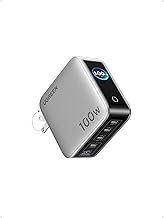
A single multi-port GaN charger can replace a drawer full of separate power bricks — the question is which one actually fits your setup. The Ugreen Nexode Pro 100W and Anker 737 are two of the most-recommended options in the 100W-class GaN charger category. This comparison is based on manufacturer specifications and published spec-sheet data; we don't test chargers in-house.
Some links below are affiliate links — we may earn a commission if you buy through them, at no extra cost to you. See our full disclosure.
The quick answer
Get the Ugreen Nexode Pro 100W if you want more ports and a more detailed smart display — 4 total ports (3× USB-C, 1× USB-A) and a rotatable display that shows per-port wattage, charging protocol, and temperature, at a lower price than the Anker. Get the Anker 737 if you want Anker's charging-distribution tech and a slightly smaller footprint — 3 ports (2× USB-C, 1× USB-A) with PowerIQ 4.0 dynamic power distribution and a simpler wattage display, at a higher price. If you only ever charge one device and want something pocket-sized, the single-port Anker Nano II 65W is a smaller, cheaper alternative to either.
Check current price on the Ugreen Nexode Pro 100W →
Comparison at a glance
| Feature | Ugreen Nexode Pro 100W | Anker 737 (GaNPrime 120W) |
|---|---|---|
| Price | Check current price | Check current price |
| Max output (W) | 100W total | 120W total, 100W max per single device |
| Ports | 3× USB-C, 1× USB-A (4 total) | 2× USB-C, 1× USB-A (3 total) |
| GaN tech | Yes | Yes (HFB topology + PowerIQ 4.0) |
| Smart display | Rotatable, shows wattage/protocol/temperature per port | Shows real-time wattage draw |
| Per-port speeds | Intelligently distributed across up to 4 devices | Dynamic Power Distribution across 3 devices |
| Laptop charging | Up to 100W on one port | Up to 100W on one port |
| Travel/plug | Foldable US plug | 40% smaller than Apple's 140W charger, 194.9g |
| Safety | Overheat/overvoltage/overcurrent/short-circuit protection | Temperature monitoring, surge protection |
Ugreen Nexode Pro 100W: overview
Ugreen's Nexode Pro line leans into information density — its headline feature is a smart display that rotates to stay readable regardless of outlet orientation, and shows total output, individual port wattage, charging protocol, and internal temperature in real time. With 4 total ports at 100W combined output, it's built to charge more devices at once than the Anker, intelligently splitting power across whatever's plugged in.
Anker 737: overview
The Anker 737 (marketed as GaNPrime 120W) is built around Anker's own charging tech — a jointly-developed HFB topology with Infineon, plus PowerIQ 4.0 Dynamic Power Distribution that detects each connected device's power needs and adjusts automatically. It has fewer ports than the Ugreen (3 vs 4) but a single port can still push up to 100W to fast-charge a laptop, and its smart display shows real-time wattage draw, though with less detail than the Ugreen's protocol/temperature readout.
Max output & ports
The Ugreen edges ahead on raw port count — 4 total (3 USB-C + 1 USB-A) vs the Anker's 3 (2 USB-C + 1 USB-A) — which matters if you regularly charge more than 3 devices from one outlet. Total wattage is close: Ugreen caps at 100W combined, while Anker's 120W total allows a bit more headroom across multiple devices, though any single port on either charger tops out around 100W for laptop charging.
Smart display & power distribution
This is where the two diverge most in philosophy. Ugreen's display is the more information-dense of the two — rotatable, and showing per-port protocol and temperature alongside wattage, useful if you want to actually diagnose why a device isn't charging at full speed. Anker's display is simpler, focused on real-time wattage draw, backed by its PowerIQ 4.0 system automatically redistributing power as devices are plugged and unplugged.
Laptop charging speed
Both can push up to 100W to a single port, which is enough to fast-charge most USB-C laptops including MacBook Pro models. Neither charger will out-charge the other on a single device — the real difference shows up when multiple devices are plugged in simultaneously and each charger's power-distribution logic decides how to split the available wattage.
Size, travel & safety
The Anker 737 is specifically marketed on its compactness — about 40% smaller than Apple's own 140W charger, at under 200 grams, making it a strong travel pick despite having one fewer port than the Ugreen. Both include the standard GaN-charger safety set: overheat, overvoltage, overcurrent, and short-circuit protection, with the Ugreen also adding a foldable US plug for travel.
Check the current Ugreen Nexode Pro 100W price → · Check the current Anker 737 price →
Pros and cons
Ugreen Nexode Pro 100W - ✅ 4 ports — most of the group - ✅ Most detailed smart display (protocol + temperature) - ✅ Lower price - ❌ Slightly bulkier than the Anker for travel - ❌ Ugreen's charging ecosystem is less established than Anker's
Anker 737 - ✅ Anker's PowerIQ 4.0 dynamic distribution tech - ✅ More compact for travel (40% smaller than Apple's 140W brick) - ✅ 120W total output headroom - ❌ One fewer port than the Ugreen - ❌ Higher price
Verdict — choose Ugreen if / choose Anker if
Choose the Ugreen Nexode Pro 100W if you regularly charge multiple devices at once and want the most detailed real-time charging information, at a lower price.
Choose the Anker 737 if you want Anker's charging-distribution technology and the most compact footprint for travel, and don't mind paying more or having one fewer port.
See also
FAQ
Can it charge a MacBook Pro at 100W? Yes — both the Ugreen Nexode Pro 100W and the Anker 737 can deliver up to 100W to a single port, enough to fast-charge most USB-C MacBook Pro models.
What does the smart display show? The Ugreen's display rotates and shows per-port wattage, charging protocol, and internal temperature. The Anker's display shows real-time wattage draw per device, with less detail than Ugreen's readout.
Which is best for travel? The Anker 737 is specifically built to be compact — about 40% smaller than Apple's 140W charger at under 200 grams. If you're only ever charging one device on the go, the single-port Anker Nano II 65W is smaller and cheaper than either.
The Workflow Guide publishes independent research and comparisons for remote workers, creators, and small teams. We do not test chargers in-house; this guide is based on manufacturer specifications and published spec-sheet data, and is reviewed by our editor before publishing.
Connection, audio, light, camera, desk and power, in the order that matters. Free 2-page PDF, no spam.
No spam. Unsubscribe anytime.
Products compared
Based on published specs and owner reviews — not hands-on testing.
- UGREEN Nexode Pro 100WCheck price →
- Anker 737
Founder of The Workflow Guide — an IT professional who researches home-office gear and productivity software from specs, documentation and published reviews. Full bio →